
DIY Halloween Village Display: How to Build a Spooky Miniature Village
I fell in love with Halloween village displays after seeing an elaborate one at a local gift shop, complete with lights, sound, multiple levels, and tiny spooky details. I knew I wanted to create my own version — just on a much more realistic budget.
This DIY Halloween village display uses a simple raised base, layered ground cover, roads, landscaping, lights, and miniature accessories to create a full spooky scene without spending a fortune.
The best part is that you can customize the size and layout to fit the village pieces you already own and the space where you plan to display it.
And because Halloween has always been my favorite holiday, I was more than happy to take on the challenge.
This post may contain affiliate links. If you choose to purchase a recommended product, I may receive a small commission at no additional cost to you. Rest assured that I will not recommend any product that I would not use myself. For our full policies and disclosures click here.
What You’ll Need for a DIY Halloween Village Display
- 1 x 2 boards for the raised base frame
- 2 x 2 boards for the legs
- Foam insulation board in different thicknesses
- Foam cutting tool, razor blade knife, or electric carving knife
- Spray Paint or black fabric/material to cover the base and/or foam board
- Sheet moss , stone dust, gravel, small rocks or other ground-cover material
- Textured material for roads and pathways
- Halloween village houses and light-up accessories
- Power strips and extension cords
- Miniature fencing Trees and bushes
- Pumpkins, gravestones, people, vehicles, signs, and other Halloween village accessories
You don’t need every item on this list to make a great display. Use the village pieces and materials you already have, then add inexpensive landscape materials and accessories as you build your scene.
KEEP READING
Love decorating for Halloween?
Check out more of my favorite Halloween DIYs and decorating ideas.
How to Make a DIY Halloween Village Display
Step 1: Build the Halloween Village Base
Start by building a simple raised base to hold your Halloween village display. I made mine to fit on top of an 8-foot folding table, but you can adjust the size to fit whatever table or display surface you plan to use.

To make the base, cut 1 x 2 boards and assemble them into a rectangular frame. Then attach 2 x 2 legs to raise the frame off the table. This creates a hollow space underneath the display, which is perfect for hiding cords, power strips, and plugs.
I covered the visible parts of my base with black material so the wood frame would blend into the finished display instead of standing out underneath it. But, you could also spray paint it black.
Once the frame is built, place your first layer of foam board on top. This gives you a lightweight surface to start building the village on while also letting you plan where each house, lamp post, or other light-up accessory will go.
One of the biggest benefits of this raised base is that it makes it easy to hide electrical cords. After deciding where each piece should be placed, you can simply punch holes through the foam board and feed the cords down into the open space inside the base. That way the wiring stays tucked underneath the display instead of being visible across the top.
If you plan to use several lit buildings or accessories, this step is well worth it. It keeps the display looking cleaner and gives you more flexibility when arranging your Halloween village.
Step 2: Create the Raised Levels and Platform
To create the different heights in the display, I used pink insulation board. This is what gave the Halloween village its layered look and made it feel more like a real miniature landscape instead of a flat display.

Start by cutting your first piece of insulation board to fit the overall size of your display. (See different cutting methods in the materials list.) This becomes the top layer of your base and sits on top of the raised frame from Step 1. You could use plywood here if you want a more permanent structure, but it will make the display much heavier. I chose insulation board because it was lightweight, easy to cut, and simple to work with.
Next, decide where you want your second and third levels to go. Think about how the display will be viewed. Since mine was placed against a wall, I kept the lowest levels in the front and built the highest levels in the back so everything could still be seen. If your display will be viewed from all sides, it usually makes more sense to place the highest section in the center and build lower levels around it.
You can create the raised areas by cutting additional pieces of insulation board and stacking them where you want more height. I used different thicknesses to make the levels feel more natural. For example, I used a thicker board for the main base, a thinner one for the next level, and then another thicker section for the highest area.
Mixing the board thicknesses helps create a more realistic, uneven landscape and gives you better spots for placing houses, trees, fences, and other village details.
Before adding the ground cover, you can paint any exposed foam board or visible base areas a dark color so they blend into the landscape. I used black, which worked well for hiding the foam and creating a shadowed background underneath the moss, rocks, and other materials.
If you want to spray-paint the foam, make sure the paint is labeled safe for foam; otherwise use an acrylic or other foam-safe paint. I’ve used paint on foam board for many projects and I love it because it paints really nice weather your using a spray paint or acrylic paint a brush.
Step 3: Add Halloween Village Ground Cover
Once you’re happy with the shape and height of your levels, you can start finishing the exposed edges of the insulation board.

For a rocky or natural look, leave some of the edges uneven and jagged, then paint them to resemble stone. If you plan to glue moss, felt, or another material over an area, smooth the surface enough so the ground cover will adhere well.
For my Halloween village ground cover, I used a combination of sheet moss, felt, sand, and stone dust. Mixing different textures helped the display look more natural and kept the landscape from feeling too flat or uniform.
note: If you are using sand or stone dust you need to be careful when moving the display because it doesn’t all adhere to the base and will make a mess.
You don’t have to buy everything new, either. Small stones, twigs, dried moss, gravel, or other natural materials from your yard can work well depending on the look you’re going for. Just make sure anything you bring in from outside is clean and completely dry before adding it to the display.
Step 4: Arrange the Village Houses
Now it’s time to start placing your Halloween village houses on the different levels.

Set the houses in place, then move them around until the overall layout feels balanced. Try viewing the display from the angle it will normally be seen from so you can make sure the taller buildings aren’t blocking smaller ones.
I treated each raised section almost like its own little yard or property for a house. That helped the village feel more realistic and gave me space to add roads, fences, trees, pumpkins, and other landscaping around each building.
There’s no right number of houses to use either. Work with the pieces you already have and leave enough open space between them for the landscape and small details that will make the whole Halloween village display come together.
Once you are happy with your house layout, and your village houses and accessories light up, now is the time to plan your cords. I made holes in the foam board where I needed them (mostly under the houses where you wouldn’t see a hole) and ran the cords through the holes and down into the raised base, where I hid power strips underneath. This kept the top of the display looking clean and made it much easier to light multiple pieces without cords running across the roads and ground cover.
If you need to make holes for smaller accessories, don’t worry about seeing the holes. You can always disguise the holes in the end with more landscape materials.
KEEP READING
Looking for Halloween village pieces?
Lemax Spooky Town has houses, characters, accessories, and miniatures that work great for building out a Halloween village display.
Step 5: Create the Roads and Landscape Layout
Once your houses are in place, start connecting the different areas of your Halloween village with roads, pathways, fences, walls, trees, and other landscape elements.

Think of each house or raised section as part of the same little neighborhood. Roads and paths help guide the eye through the display and make all of the separate pieces feel like they belong together.
Start with the larger features first, such as roads, walkways, ponds, or streams. Then fill in around them with fences, stone walls, trees, shrubs, and other Landscape features.
At this stage, you’re still mainly planning the layout, so don’t worry about making everything permanent yet. Move things around until the roads and landscape elements connect the houses in a way that feels natural and balanced.
For my display, I used textured felt strips for the roads, which was an easy way to create winding paths without adding much bulk. (I tried to find the product I used here but couldn’t find it, but I linked some great alternatives in the materials list.)

Step 6: Connect the Village and Blend the Landscape
Now it’s time to connect the different parts of your DIY Halloween village so the houses, roads, levels, and landscape feel like one cohesive display.
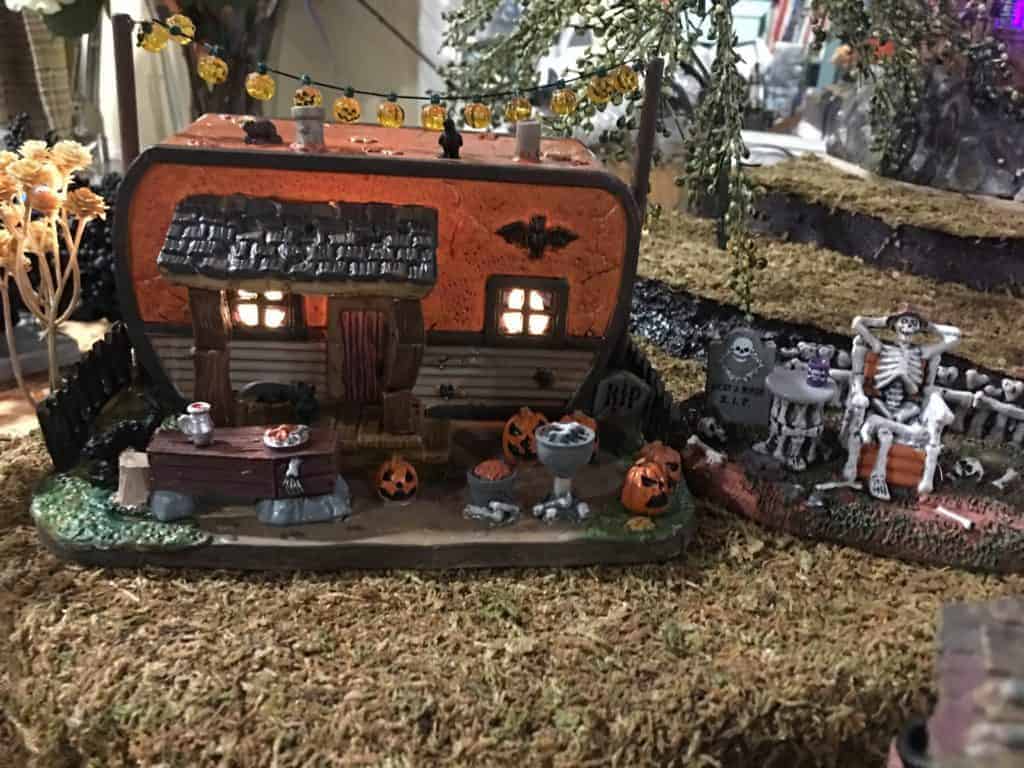
Use rocks, moss, grass, paint, small retaining walls, fences, and other ground materials to soften the edges between sections and hide any rough transitions in the foam board.
You can also use these elements to visually connect one house or “yard” to the next so the entire village feels intentional instead of like separate pieces sitting next to each other.
At this stage, keep focusing on the landscape itself. Save the pumpkins, people, gravestones, vehicles, spooky props, and other small accessories for the final step.

KEEP READING
Want a more detailed Halloween village collection?
Department 56 has several Halloween village collections with really fun houses and accessories. They’re definitely more of an investment than some other options, but the pieces tend to be more detailed and collectible.
Step 7: Add the Finishing Touches
Now comes the fun part — adding all the little details that give your Halloween village personality.

Fill in the scene with pumpkins, people, animals, gravestones, skeletons, signs, vehicles, lights, and other miniature Halloween accessories. Create small scenes around the village instead of scattering everything randomly — a cemetery, a pumpkin patch, a spooky porch, or a little gathering of characters can make each area feel like its own story.
Try to spread the details throughout the display so there’s something interesting to discover in every section without making it feel overcrowded.
These finishing touches are what take the village from a collection of houses and landscaping to a full spooky Halloween scene.
I use the same idea when creating larger Halloween setups—one strong theme with smaller scenes and details around it. You can get some great tips and ideas from my post “13 Halloween Camping Ideas”.
Halloween Village Display Ideas
A Halloween village can be displayed in all kinds of ways, from a large layered setup like mine to a small scene on a mantel or shelf. The best spot really depends on how many pieces you have, how much space you want to use, and whether the village will be viewed from the front or from all sides.
Planning the display location first can also help you decide how large to make the base and where to place the tallest levels.
- Folding table: best for a large, layered village
- Console table or buffet: great for a medium-size display against a wall
- Mantel: better for a smaller village with fewer pieces
- Bookcase or shelves: lets you create separate little scenes on each level
- Dining room sideboard: gives you a wide surface without taking over the room
- Entry table: works well for a compact village that guests see right away
- Corner display: useful if you want to build upward and create more depth
- Center-of-room display: if it can be viewed from all sides, put the tallest sections toward the middle
If you love creating larger themed Halloween displays, you might also like my DIY Haunted Mansion Halloween decorations.


Building a DIY Halloween village is really about creating layers, connecting the landscape, and then adding the little details that make the whole scene come to life. Start with the pieces you already have, build your display to fit your space, and add to it over time. It doesn’t have to be huge or expensive to feel really special.
Here’s a quick video of the finished village lit up on Halloween night. It was filmed in a dark room so you could see the lights and glowing details throughout the display.
FAQ’s
You can use sheet moss, felt, sand, stone dust, gravel, small rocks, or other textured materials for Halloween village ground cover. Mixing a few different textures helps the landscape look more natural and keeps the display from feeling flat. Don’t forget to check your own yard before buying items to use for ground cover.
The easiest way is to build a raised base and run the cords underneath it. I punched small holes through the foam board near each light-up house or accessory, fed the cords down through the holes, and kept the power strips hidden inside the base.
Textured felt works well for Halloween village roads because it is easy to cut into curves and doesn’t add much bulk. You can also use craft foam, fine gravel, sand, or textured modeling materials depending on the look you want.
A Halloween village can be displayed on a folding table, console table, buffet, mantel, shelf, bookcase, or other sturdy surface. For larger displays, a table gives you more room to create raised levels, roads, and separate themed areas.
You can find Halloween village houses and accessories at craft stores, home décor stores, seasonal retailers, online marketplaces, and secondhand shops. I also like checking thrift stores, yard sales, and marketplace listings because village pieces can get expensive and you can often find older or unusual pieces for much less.
More Great Halloween inspiration posts…



Want to see more from Our Repurposed Home?
Just add me as a Preferred Source on Google and you may see more of my ideas when you search.
 Add Me on Google
When Google opens, just check the box next to Our Repurposed Home.
Where did you get your tiny pumpkins for your patch?
I got them at Michael’s Crafts years ago.
What did you use for the streets? They look amazing – awesome job!
Thank you 😊 They’re cut up strips of textured felt that looks like pebbles